Your AI agents stop when you do. NonStopWorker keeps them working.
The controller that keeps your work running across every AI engine you already pay for. A folder of tickets goes in, finished work comes out: day and night, on your own server, within a budget that holds.
Not another platform. The controller.
NonStopWorker does one thing, and does it well: it keeps the work going. It does not hold your code, your tickets or your keys, and it does not decide which AI you may use. You keep room to move.
Self-hosted
On your own server, VPS or laptop, in your own secure environment. Your code and your keys never leave it.
No lock-in
Claude Code, Codex, Gemini, OpenCode, or any agent with a command line: each one is a line in a config file.
One program
930 kilobytes. No database, no runtime, no account. Install it in minutes; remove it in seconds.
Built to scale
A one-time fee, not a fee per seat or per month. Add lanes and engines as your work grows.
What goes wrong today, and what it does about it
Teams that already work with AI agents run into the same walls. Each one is a feature here.
How it works
Three steps, and the second one repeats all night.
Put work in a folder
A ticket is a Markdown file: what to do, its priority, its budget. Write it by hand, from a script, or ask your own assistant over MCP.
It picks, routes and runs
The next ticket, the right weight of model, the first engine that can. Limits and outages are handled on the way, and lanes run side by side.
Finished work, measured
The result in your repository, a worklog in the ticket, and what it cost: tokens, euros, time, which engine.
A budget that holds
Every ticket can carry its own maximum. Every call is booked: engine, subscription or API, tokens, euros. When the day's budget is spent, no API is touched until tomorrow. And every finished ticket says what it really cost.
Subscriptions first, the API only when you allow it: a key is never handed to an agent that runs on its subscription, so nothing pays per use by accident.
tickets/0009-refactor-export.md
---
status: done
priority: P1
budget: 1.00
spent: 0.412
---
Refactor the export module ...

## Worklog
- 02:23 router (jev): kind=code, weight=heavy
- 02:23 claude (subscription, floris1) reached its limit -> codex
- 03:05 codex (subscription, floris2): done
- 03:05 measured: EUR 0.41 of EUR 1.00, 1 turn, 42 min
See it at a glance
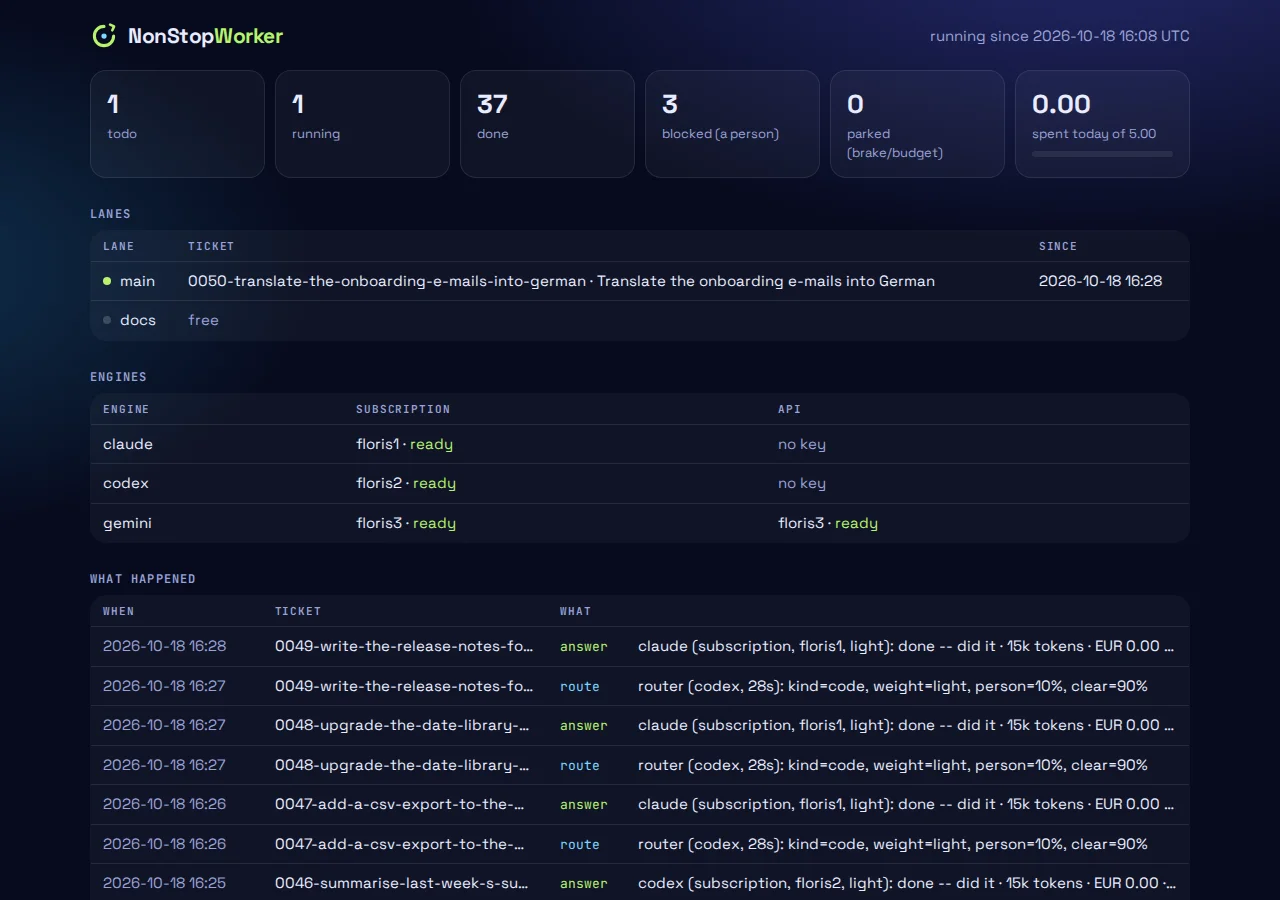
A status page on your server shows what runs, what rests, what it cost today and what happened. Read only: you steer by editing the files, or from your assistant. Watch the live demo: stand-in engines, real scheduler.
One-time fee. No subscription.
You buy it once and run it on as many of your own servers as your work needs. Your AI costs stay where they are, with the providers you choose.
- Self-hosted, in your own environment
- Every engine you already use
- Failover, routing, budgets and the brake
- Status page and MCP
Talk to us
Is Floris Knol guiding your AI project? Then NonStopWorker comes with it: the technology, set up on your own systems, as part of the work. How that works
Questions
Which AI agents does it work with?
Claude Code, Codex, Gemini CLI and OpenCode out of the box, each on its subscription or its API. Any other agent with a command line is one line in the config.
Where does my code go?
Nowhere new. The agents work in a folder on your server, and NonStopWorker itself sends nothing anywhere. Only the AI providers you choose see what their agent works on.
What does it need to run?
A Linux machine: a VPS, a bare-metal server or a laptop. The program has no dependencies; the agents' own command lines are installed beside it.
How does it decide which model does what?
Before each ticket a decision model answers four questions in a fraction of a second: what kind of work, how heavy, whether a person must do it, and whether it is clear enough to start.
What happens when every engine is at its limit?
The ticket waits, with the time it will try again in its worklog, and nothing is lost. The status page shows which engine rests until when.